Garden Grove Blast Radius and Evacuation Zone: What the Map Shows
The Garden Grove blast radius explained: the ~1-mile evacuation zone, which cities and schools were affected, and why the May 2026 chemical tank couldn't be fixed.
Get Garden Grove incident updates
Want a plain-language summary when official guidance changes? Enter your email and we will only use it to send updates about this incident. We are not a medical or legal provider.
How we handle your informationLatest updates
Updated May 26, 2026 · developing story- May 25
- Orange County Fire Authority said the threat of a catastrophic blast (BLEVE) was off the table after a crack in the tank began to relieve pressure overnight.
- Evacuation orders were reduced by about 65 percent in the evening. Roughly 34,000 residents were allowed to return; about 16,000 remained under the order, in a tighter zone bounded by Orangewood Avenue, Dale Street, Knott Street, and Garden Grove Boulevard.
- The tank's internal temperature trended down from about 100°F to 93°F. Normal operating temperature is closer to 50°F, and officials cautioned that a smaller release or spill is still possible.
- The President approved a federal emergency declaration for the incident.
- May 24
- A crack in the tank was confirmed Saturday night, which would later begin to relieve pressure. Crews continued cooling the tank with a water curtain while officials consulted outside experts.
- May 23
- California Governor Gavin Newsom declared a state of emergency for Orange County.
- The Orange County District Attorney opened an investigation into GKN Aerospace and set up an anonymous tip line, asking employees to come forward.
- Evacuations expanded to more than 50,000 people across roughly nine square miles, bounded by Ball Road, Trask Avenue, Valley View Street, and Dale Street.
- Two residents filed a class-action lawsuit against GKN Aerospace, and crews built containment channels to keep leaking chemical out of storm drains.
- May 22
- The tank's internal temperature climbed from about 77°F in the morning to about 90°F at night. Readings showed it heating, not cooling, near 1°F per hour, and evacuation orders were reinstated and widened.
- May 21
- Orange County Fire Authority responded at about 3:40 p.m. to the overheating 34,000-gallon tank, which held roughly 7,000 gallons of methyl methacrylate. First evacuations went out, then lifted that night once the relief valve closed.
Compiled from public reporting (KTLA, ABC7, CBS Los Angeles, and Wikipedia). A developing situation; for current status and evacuation orders, follow local emergency authorities.
See whether your area was in the zone
These aerial views go from the regional picture down to the tanks themselves, so you can place your street relative to the evacuation area. They are for orientation only. For the official boundary and current status, follow local emergency authorities.
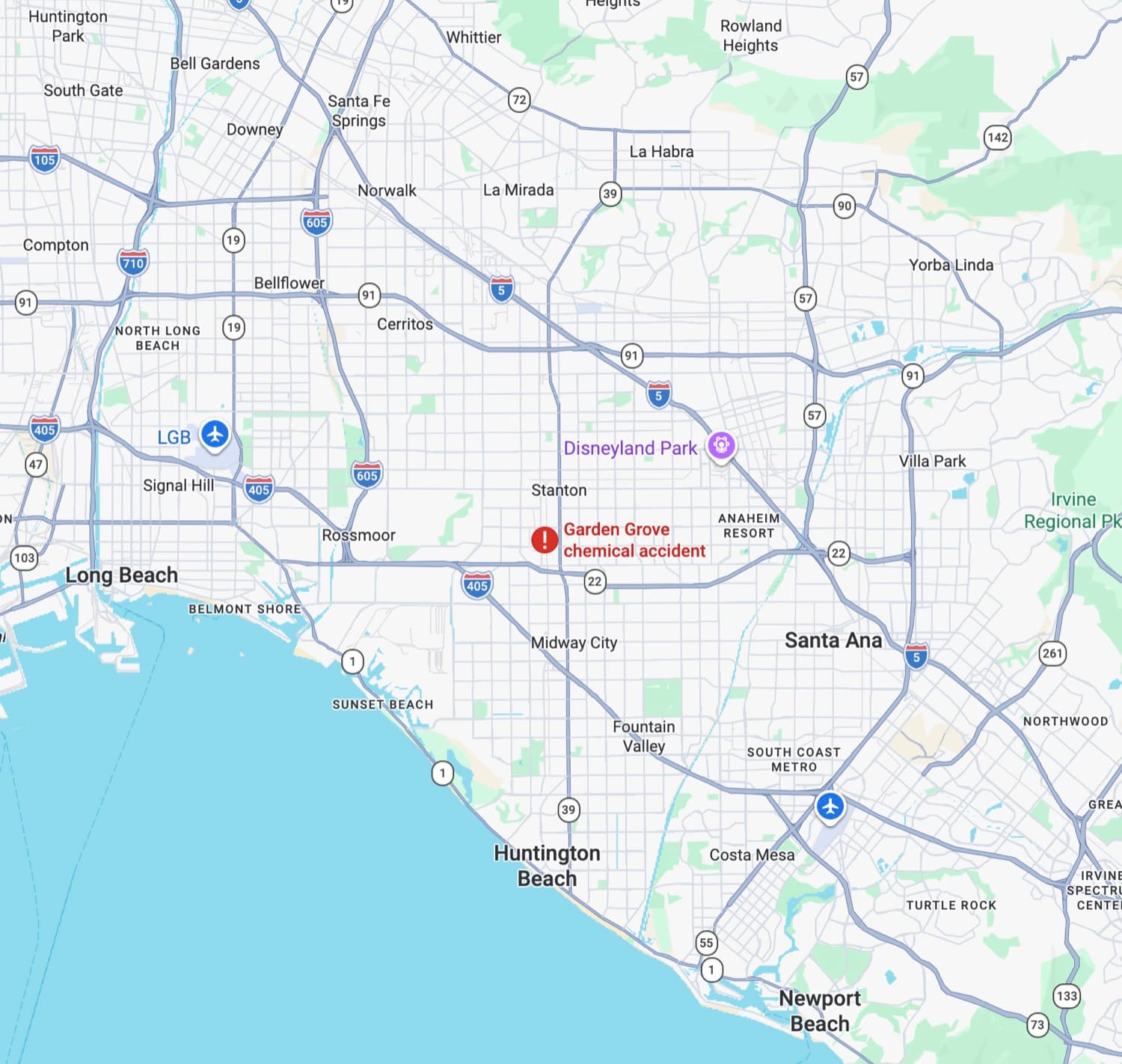
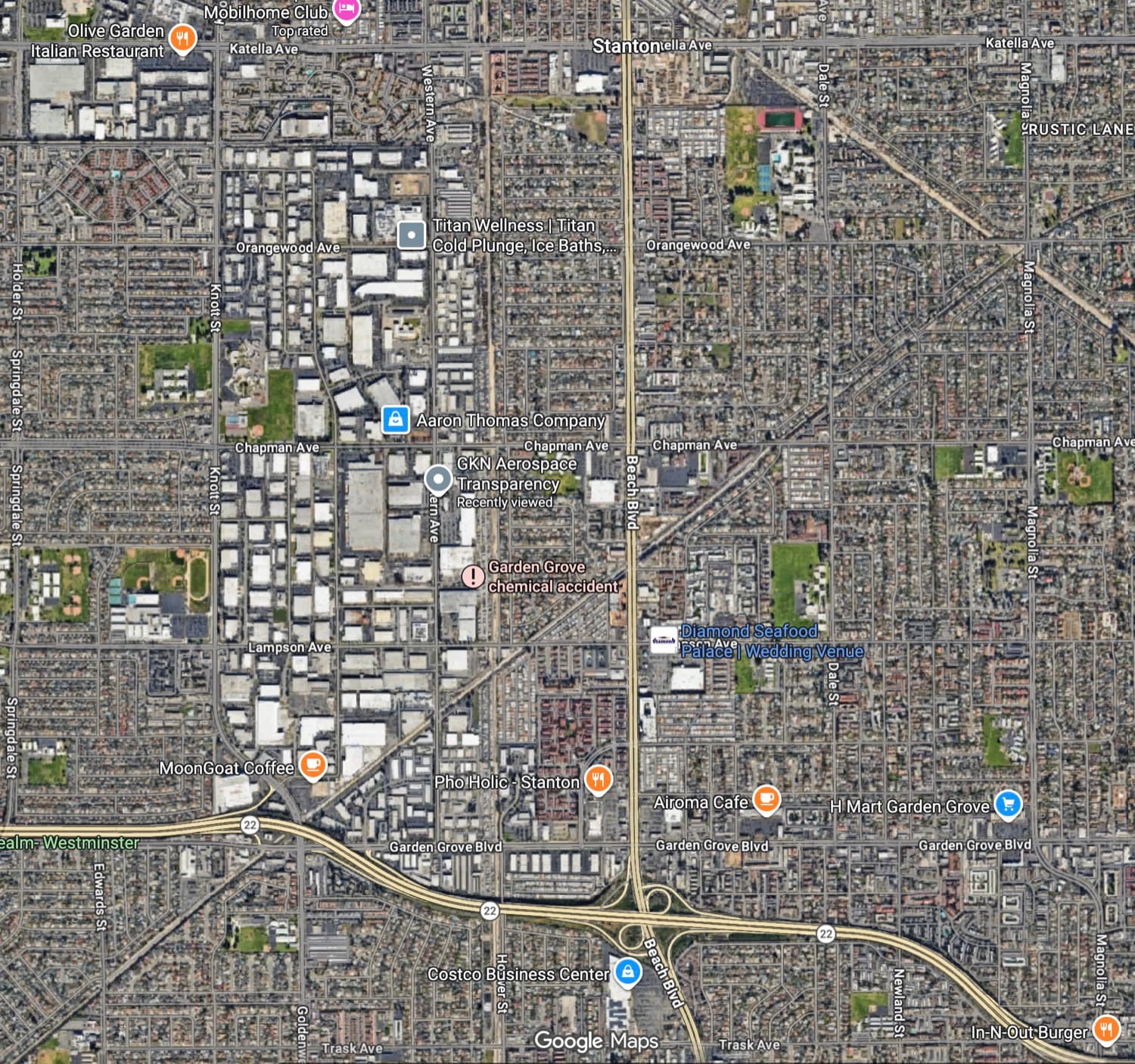
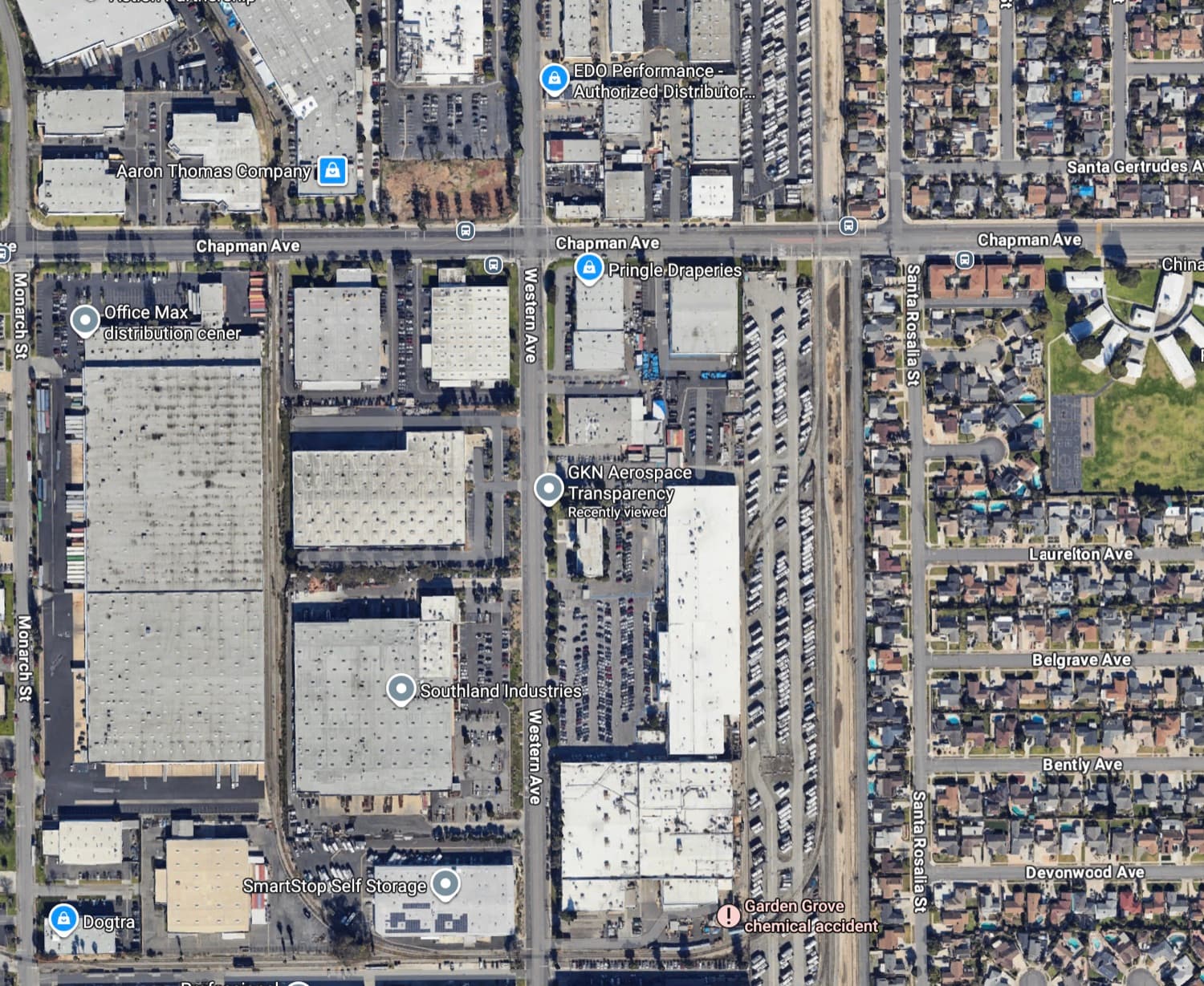
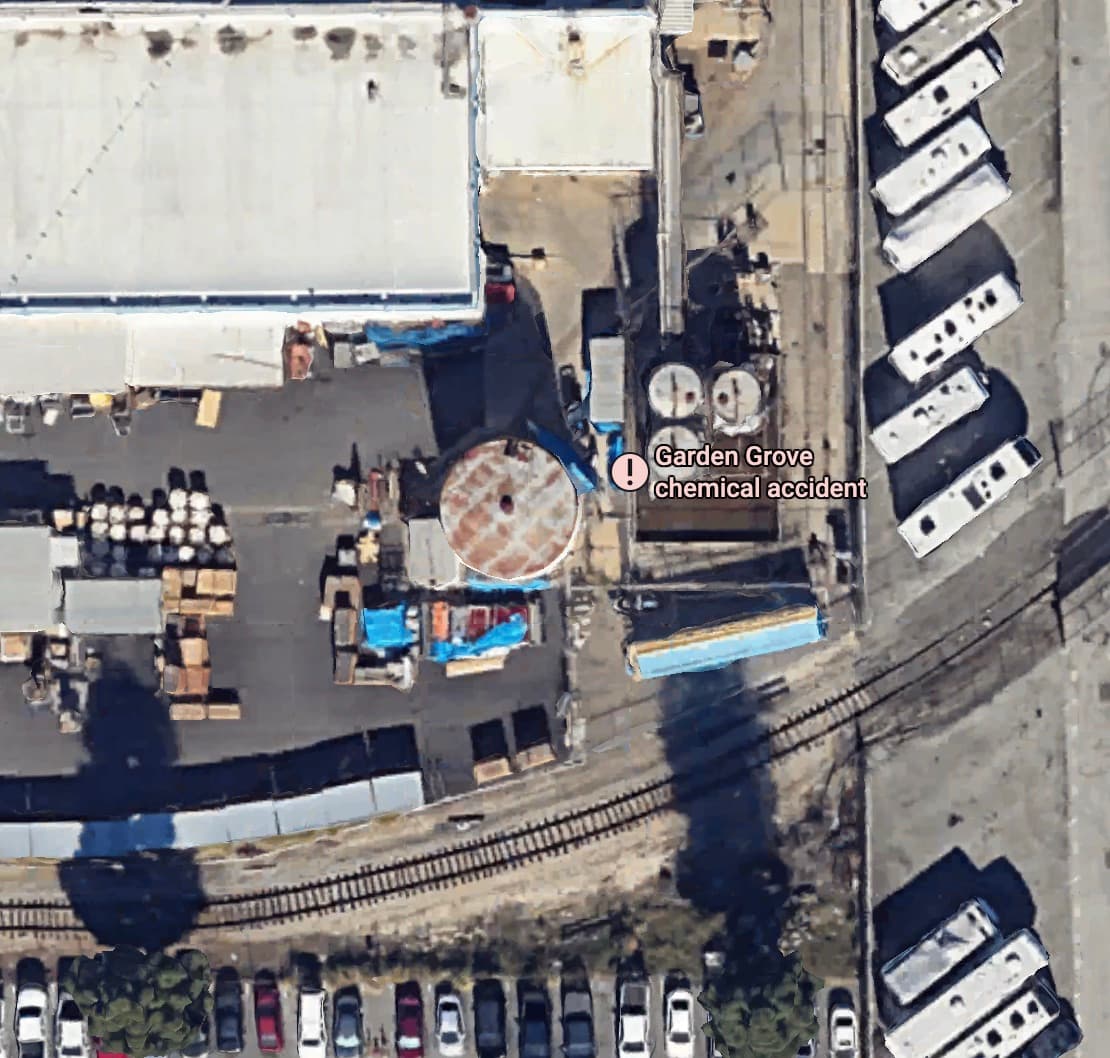
Imagery: Google Maps / Google Earth, annotated. Boundaries are approximate and for orientation only.
In May 2026, a 34,000-gallon storage tank of methyl methacrylate (MMA) at the GKN Aerospace facility on Western Avenue in Garden Grove, California overheated, and a faulty valve left no safe way to relieve it. Officials evacuated roughly 40,000 people within about a one-mile radius and warned the tank would either spill thousands of gallons of a hazardous chemical or run away and explode. Below: what the blast radius covered, who was affected, and why the tank couldn't be fixed.
(Details here are summarized from public news reporting in May 2026 and were still developing at the time of writing. The people who were evacuated are the ones who matter most in this story.)
How big was the blast radius and evacuation zone?
The evacuation was built around a roughly one-mile radius of the tank, and it crossed city lines. As reported, the order covered the area north of Garden Grove Boulevard, east of Monarch Street, south of Orangewood Avenue, and west of Beach Boulevard — reaching into Garden Grove, Cypress, Stanton, Anaheim, Buena Park, and Westminster. About 40,000 residents were told to leave, and 15 Garden Grove Unified campuses closed, with nearby schools canceling outdoor activities.
The reason the radius was drawn that wide was the worst case: officials warned that if the tank went into thermal runaway, other nearby tanks were within the blast radius, which is why a single failing vessel turned into a multi-city evacuation. The map above approximates the zone from public reporting; the exact boundary shifted as the response continued.
What happened, step by step
The sequence, as reported, was fast:
- Vapor release. Firefighters responded to vapor escaping the MMA tank at the aerospace facility, which had heated up.
- The valve fails. The initial leak was controlled, but a faulty valve left no working relief path, so crews could not bleed off pressure or add a neutralizer the way they normally would.
- Two outcomes left. Officials described either a spill of roughly 6,000 to 7,000 gallons, or thermal runaway and an explosion that could take other nearby tanks in the blast radius.
- Evacuation. Orders went out for about 40,000 residents across six cities, and 15 schools closed.
- Buying time. Crews held the damaged tank under a continuous water curtain. No injuries were reported in the early coverage.
Why the tank couldn't just be repaired or neutralized
MMA is a monomer — small molecules that, given enough energy, link into long chains (polymerize). To keep that from happening in storage, it's shipped with a small amount of inhibitor. The catch is that the common inhibitors only work while there is dissolved oxygen in the liquid. Heat is the enemy of both: it speeds the reaction and consumes the oxygen and inhibitor that were holding it back.
Once polymerization actually starts, it releases heat, and that heat drives more polymerization. The reaction accelerates itself. At that point you can't dose your way out of it — adding more inhibitor into an oxygen-starved, self-heating tank doesn't reverse anything: by the time the reaction is running, only earlier detection could have helped.
What may have gone wrong
We don't speculate about the specific facility, and the investigation will take months. But the emergency removed every safe option through a pattern operators will recognize — and these are the failure classes that produce it:
- A safety-critical valve that wasn't working when it was called on. A relief or treatment path only matters on the worst day. Corrosion, fouling, a stuck or mis-set valve, or a component that drifted out of spec is invisible until the moment it's needed — unless someone re-verifies it on a schedule.
- A heat source, or a loss of cooling, that wasn't caught early. Something raised the tank's temperature. A shell heating toward its danger zone is a slow signal that should be visible long before it forces an evacuation.
- Inhibitor and oxygen management. MMA's stability depends on inhibitor and dissolved oxygen. If either was depleted — by heat, by time in storage, or by how the tank was blanketed — the safety margin was already shrinking before the valve mattered.
Is the danger over?
As of the early reporting, crews had not fully stabilized the tank; officials described it as an active crisis and held the temperature down with a water curtain to buy time. No injuries were reported in the initial coverage. For the current status, follow local emergency officials and news outlets — this account reflects what was public in May 2026, not a final determination.
The lesson for operators
Garden Grove will be studied as a chemical incident. For anyone who runs regulated physical operations, the more useful lesson is quieter: the failures that close a facility usually start as the inspection nobody finished. We dug into that underneath-the-chemistry story — the valve, the inspection gap, and what catching it early looks like — in our companion piece, the Garden Grove chemical tank emergency: what happened and why it couldn't be fixed.
That's the kind of software we build at Sytepoint. For the engineering version — the valve schematic, the thermal-runaway curve, and how a safety-critical register would have surfaced the gap — see our technical breakdown of the Garden Grove failure. And if you want the broader argument for why captured inspection data is the durable asset, we wrote about why that captured judgment is the real moat.
Frequently asked
- How big was the blast radius and evacuation zone in Garden Grove?
- Officials evacuated roughly 40,000 people within about a one-mile radius of the GKN Aerospace facility on Western Avenue — the area north of Garden Grove Boulevard, east of Monarch Street, south of Orangewood Avenue, and west of Beach Boulevard. Evacuations reached Garden Grove, Cypress, Stanton, Anaheim, Buena Park, and Westminster, and 15 Garden Grove Unified campuses closed. Figures are from public reporting in May 2026.
- Which cities were affected by the Garden Grove evacuation?
- The roughly one-mile evacuation radius crossed city lines into Garden Grove, Cypress, Stanton, Anaheim, Buena Park, and Westminster. Fifteen Garden Grove Unified School District campuses closed, and schools near the zone canceled outdoor activities.
- Why was the blast radius drawn so wide?
- Officials warned that if the tank went into thermal runaway and exploded, other nearby tanks were within the blast radius. To account for that worst case, the evacuation was built around roughly a one-mile radius rather than the immediate footprint of the single failing tank.
- Why couldn't the Garden Grove tank be repaired or neutralized?
- Methyl methacrylate is a monomer kept stable by a small amount of inhibitor that only works while dissolved oxygen is present. Heat consumes both the oxygen and the inhibitor. Once polymerization starts it is exothermic and self-accelerating, so adding more inhibitor cannot reverse it. By the time the reaction is running, chemistry can't save the tank — only earlier detection of the heat trend and the failing valve could have.
- Where is Sytepoint located?
- Sytepoint is a software firm based in Phoenix, Arizona, serving clients across Arizona and the Greater Los Angeles area. We build structured inspection, quality-control, and asset-integrity software for teams that run regulated physical operations.
Guidance for nearby residents and workers
Official agencies continue to evaluate air quality and conditions around the GKN Aerospace site in Garden Grove. If you live or work nearby, or you were evacuated, it is reasonable to monitor official updates and keep a simple record of how the incident affected you. People in nearby areas may wish to document smoke or odor exposure, respiratory symptoms, evacuation costs, missed work, or possible property contamination while the details are fresh. None of this is a diagnosis or a legal judgment. It is organized information you will have if you ever need it.
What you may want to do
- Save every evacuation notice, emergency alert, and shelter-in-place message
- Note the dates, times, and how long you were displaced
- Photograph any visible residue, particulate, or property damage
- Keep receipts for hotels, meals, or temporary relocation
- Write down odors, smoke, or air-quality concerns as you notice them
- If symptoms develop, seek medical evaluation and keep those records
- Keep a simple timeline of exposure, disruptions, and missed work
For the full guidance, documentation checklist, and FAQ, see the Garden Grove incident resource center.
This resource is intended to help residents and workers organize information and monitor developments as more details become available from official agencies. It is not medical, legal, or emergency advice. In an emergency, follow your local emergency authorities, and rely on the official sources above for current evacuation orders and air-quality guidance.
The inspection that catches the valve before it makes the news.
Garden Grove came down to a safety-critical valve nobody re-verified in time. DocuPaint is the inspection and asset-integrity software we build for industrial operations: structured inspections, deficiency ratings, photo-backed findings, and a complete audit trail for every tank, pipeline, and vessel. When the check is logged, a failing valve reads as a deficiency, not an evacuation.
- Every line item rated: major deficiency, minor, or compliant
- Photo-backed findings on each item
- Offline-first in the field, syncs on reconnect
- A complete, timestamped audit trail


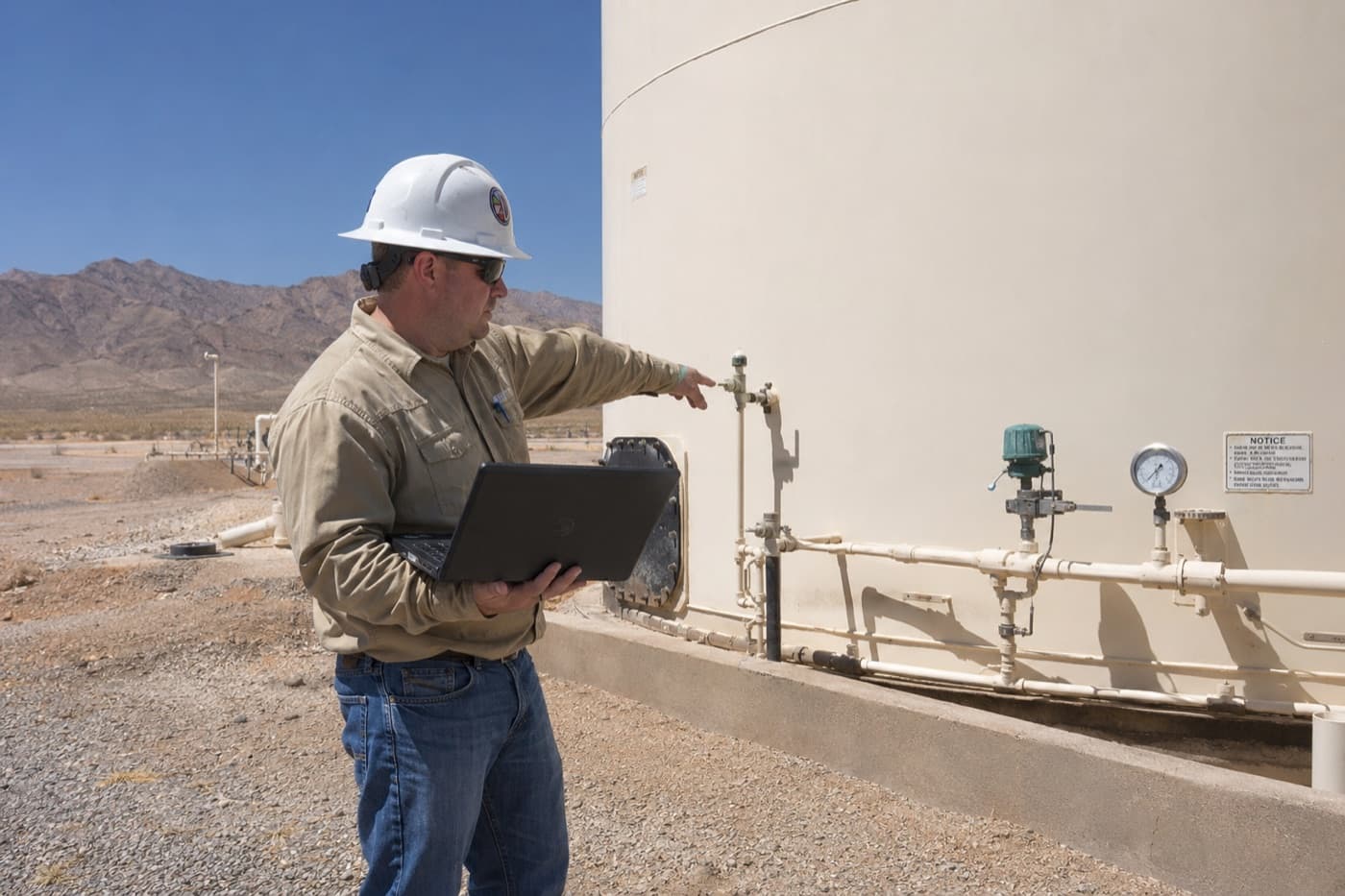

The failures that shut a facility usually start as the inspection nobody finished.
Garden Grove was a chemical story. Underneath it was a safety-critical valve and a heat trend that should have been visible long before they forced an evacuation. We build the inspection, quality-control, and asset-integrity software that surfaces that signal while it is still a maintenance ticket.